
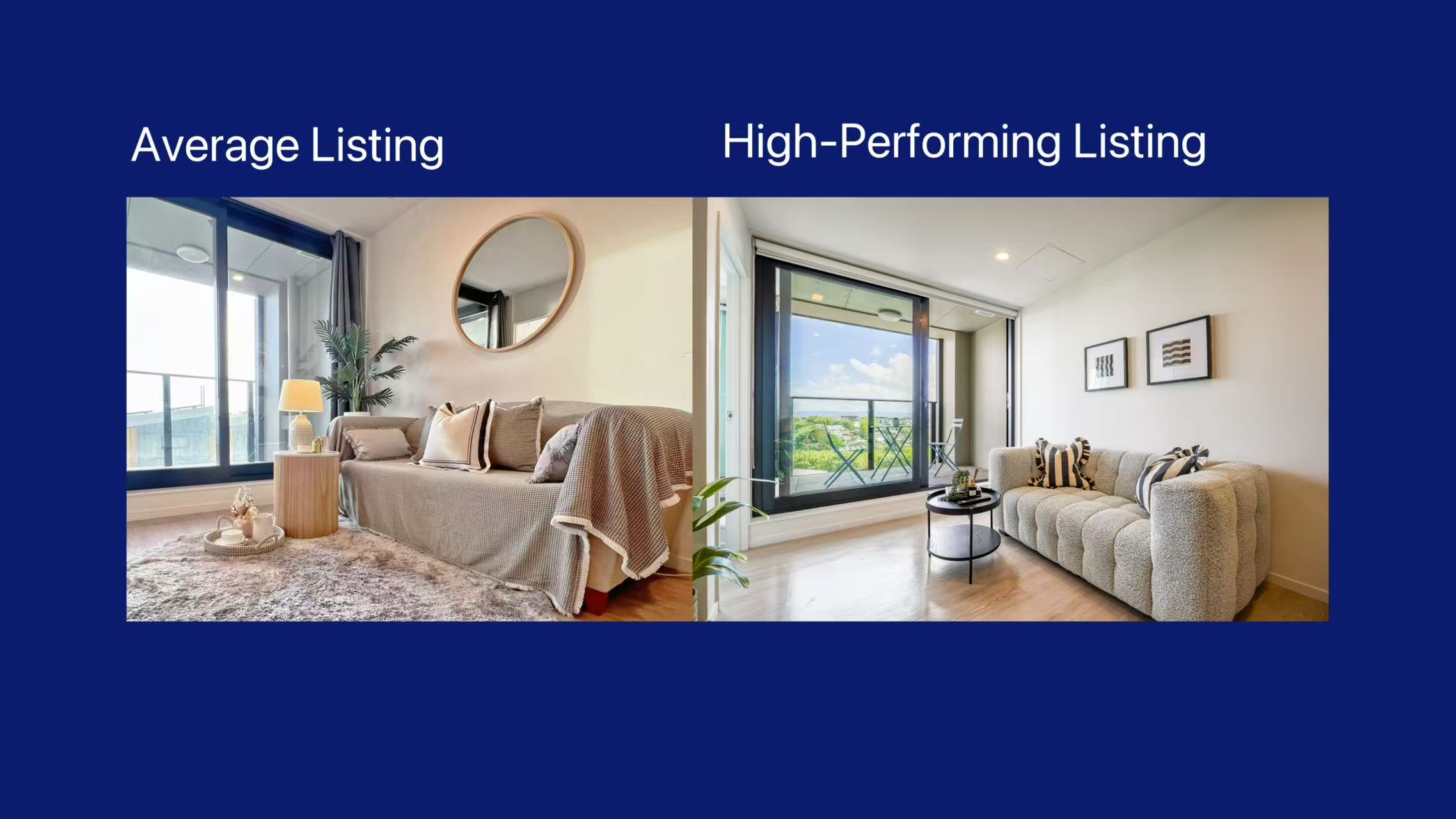
Why Some Airbnb Properties Earn Twice as Much as Others
Two Airbnb properties can be located only a few streets apart, have a similar number of bedrooms, and target the same type of guests — yet their annual revenue can look completely different.
Why?
Successful short-term rental performance is rarely determined by one factor alone. It is usually the result of several elements working together: location, photography, interior presentation, pricing strategy, reviews, and the speed and quality of guest communication.
In a competitive short-term rental market, small differences in how a property is presented and managed can create a significant difference in bookings and revenue over time.
Here are six of the biggest reasons why some Airbnb properties outperform others.
1. Location Is More Than Just the Suburb
Location is one of the strongest drivers of short-term rental demand, but it is not simply about whether a property is in Auckland CBD, Takapuna, Ponsonby or another popular area.
Guests also consider:
- Walking distance to restaurants and cafés
- Access to public transport
- Proximity to beaches and attractions
- Distance from business districts
- Parking availability
- Views
- Noise levels
- Safety and convenience
- Access to supermarkets and everyday amenities
Even within the same suburb, two properties can perform very differently.
For example, an apartment within walking distance of Britomart, Commercial Bay and the waterfront may appeal strongly to both tourists and business travellers, while another apartment further away may need a more competitive pricing strategy to achieve similar occupancy.
This is why pricing a short-term rental based only on suburb-level averages can be misleading.
The individual location of the property matters.
2. Professional Photography Can Change Booking Performance
Guests usually make their first decision about a property within seconds.
Before they read the description, check the amenities or look at the house rules, they see the photos.
Poor photography can make an excellent property appear average.
Professional photography can help communicate:
- Space
- Natural light
- Interior quality
- Views
- Layout
- Lifestyle
- Key selling points
In a search page filled with competing listings, stronger photography can improve the chances of a guest clicking on your property.
More clicks can lead to more booking opportunities.
Photography is therefore not simply about making a listing look attractive. It is part of the property’s marketing strategy.
A professionally photographed property with the right hero image can immediately create a stronger first impression than a similar property using dark, poorly composed or outdated photos.
3. Interior Styling Influences Perceived Value
Guests are not only paying for accommodation.
They are paying for an experience.
Two identical apartments in the same building may achieve very different results depending on how they are furnished and presented.
A well-styled property can feel more premium, more comfortable and more memorable.
Important elements can include:
- Furniture proportions
- Bedding
- Lighting
- Artwork
- Soft furnishings
- Colour consistency
- Decluttering
- Functional layouts
- Small decorative details
Good styling does not necessarily mean buying the most expensive furniture.
The goal is to create a property that photographs well, feels comfortable and appeals to the type of guest you want to attract.
For example, a CBD apartment targeting business travellers may benefit from a proper workspace, quality bedding and a clean, modern presentation.
A holiday home targeting families may benefit more from a comfortable living area, practical dining space and family-friendly amenities.
The property should be styled for its target market.
4. Pricing Strategy Can Make a Major Difference
One of the biggest differences between average and high-performing Airbnb listings is often pricing strategy.
Short-term rental pricing should not remain the same throughout the year.
Demand can change depending on:
- Weekends
- Public holidays
- School holidays
- Major concerts
- Sporting events
- Conferences
- Seasonal tourism
- Local accommodation supply
- Booking lead time
- Last-minute demand
A property priced too high may experience unnecessary vacant nights.
A property priced too low may achieve strong occupancy but leave significant revenue on the table.
The objective is not simply to maximise occupancy.
It is to find the right balance between Occupancy Rate and Average Daily Rate (ADR).
For example, imagine two similar properties.
Property A:
Average nightly rate: $320
Booked nights: 12
Monthly accommodation revenue: $3,840
Property B:
Average nightly rate: $270
Booked nights: 23
Monthly accommodation revenue: $6,210
Property B charges less per night, but generates significantly more total revenue.
This is why professional revenue management focuses on total performance rather than simply trying to achieve the highest nightly rate.
5. Reviews Build Trust and Improve Conversion
Reviews are one of the strongest forms of social proof in short-term accommodation.
Guests are more comfortable booking a property when previous guests consistently confirm that:
- The property is clean
- The listing is accurate
- Check-in is easy
- Communication is good
- The location is convenient
- Problems are handled quickly
A property with a strong review history may convert more browsing guests into actual bookings than a similar property with limited or inconsistent reviews.
Reviews also highlight operational weaknesses.
If several guests mention uncomfortable beds, difficult check-in instructions or cleanliness issues, these problems should be addressed quickly.
Strong Airbnb performance is therefore not just about collecting five-star reviews.
It is about using guest feedback to continuously improve the property.
6. Response Time Matters More Than Many Owners Realise
Short-term rental guests often contact multiple properties before making a decision.
If one host responds within minutes and another takes several hours, the faster response can have an advantage.
Good guest communication includes:
- Fast responses to enquiries
- Clear booking information
- Accurate check-in instructions
- Quick assistance during the stay
- Professional handling of complaints
- Helpful post-stay communication
Response time becomes even more important when guests are trying to make last-minute bookings.
A missed message can become a missed reservation.
For self-managing owners, this can become challenging because guest enquiries do not always arrive during normal working hours.
Professional management systems can help ensure that communication remains consistent even when booking activity increases.
The Best-Performing Properties Get the Fundamentals Right
There is rarely one secret that causes an Airbnb to dramatically outperform another property.
Instead, high-performing listings usually get several important things right at the same time:
Great Location + Strong Photography + Smart Styling + Dynamic Pricing + Positive Reviews + Fast Guest Communication
When these elements work together, they can create a powerful cycle.
Better presentation can generate more clicks.
More competitive pricing can generate more bookings.
More successful stays can generate stronger reviews.
Stronger reviews can improve guest confidence.
Higher guest confidence can lead to more bookings.
Over time, these small advantages can create a substantial difference in annual revenue.
Why Two Similar Properties Should Not Automatically Have the Same Revenue Estimate
Property owners sometimes compare their Airbnb with another property nearby and assume they should earn the same amount.
But short-term rental performance depends on much more than bedroom count and location.
Two two-bedroom apartments in the same building could still perform differently because one has:
- Better furniture
- Better photography
- Better reviews
- Better views
- Better amenities
- More competitive pricing
- Faster guest communication
- A stronger listing description
- Better operational management
This is why short-term rental revenue should be assessed property by property rather than relying solely on general market averages.
Can Professional Management Improve Airbnb Performance?
Professional management cannot change every characteristic of a property.
It cannot move the apartment closer to the waterfront or add a view that does not exist.
However, many of the factors that influence short-term rental performance can be actively managed and improved.
These include:
- Property presentation
- Professional photography
- Listing optimisation
- Dynamic pricing
- Minimum-stay strategy
- Guest communication
- Cleaning coordination
- Review management
- Maintenance response
- Seasonal revenue strategy
The objective is to maximise the potential of the property that already exists.
What Should Property Owners Focus On?
If your Airbnb is underperforming, lowering the price should not automatically be the first solution.
Start by looking at the entire guest journey.
Ask yourself:
Does the property stand out in Airbnb search results?
Are the first five photos strong enough?
Does the interior presentation justify the nightly rate?
Is the pricing changing with market demand?
Are guest enquiries being answered quickly?
Are negative review patterns being addressed?
Is the listing being continuously optimised?
Sometimes improving several small areas can produce a much greater result than making one major change.
Final Thoughts
The difference between an average Airbnb and a high-performing Airbnb is rarely luck.
Successful short-term rental properties are usually the result of strong presentation, intelligent pricing and consistent operational management.
For property owners, the goal should not simply be to achieve the highest possible nightly rate or the highest possible occupancy.
The real objective is to optimise the property’s overall annual revenue and net return.
If you own a property in Auckland and want to understand how it could perform as a short-term rental, Kiwi Nest Property Management can provide a free short-term rental revenue appraisal based on your property type, location and local market conditions.
Find out what your property could potentially earn with professional short-term rental management.